Module One: Serpent — The Path of Surrender 🐍 ✨
Expand each ‘plus sign’ to find the information for each module. Notes will be added and updated as the course continues. Thank you for being here!
-
Before we begin any deeper work together, we first create Sacred Space.
Opening Sacred Space is one of the foundational practices of the Andean tradition. While it may appear ceremonial on the surface, its purpose is much deeper than ritual alone.
Opening Sacred Space allows us to intentionally shift from ordinary awareness into sacred awareness.
For a moment, we step away from our responsibilities, distractions, and daily concerns and remember that we are part of something larger than ourselves.
We remember our relationship with Spirit.
With nature.
With the ancestors.
With the Earth.
With one another.
And with the living intelligence that moves through all things.
Every time we open Sacred Space, we acknowledge that healing does not happen in isolation.
We heal through relationship.
Relationship with ourselves.
Relationship with Spirit.
Relationship with nature.
Relationship with community.
Relationship with life itself.
As we move through this training together, we will continually return to this understanding.
-
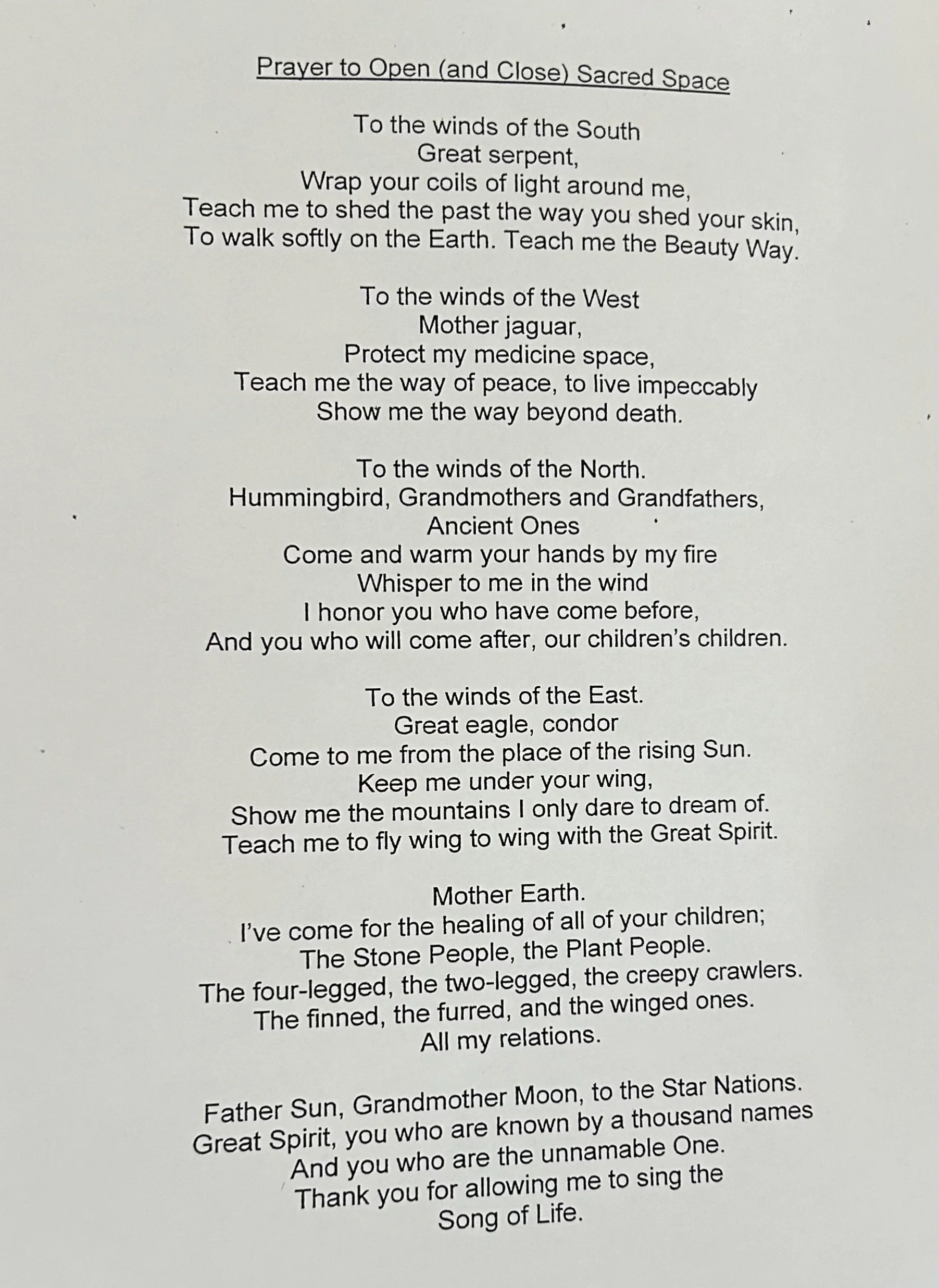
Within the Andean tradition, Sacred Space is opened by acknowledging six directions. These directions are more than physical orientations. They represent archetypal forces and living teachings that support our development throughout life.
The South: Serpent
We begin in the South with Serpent.
Serpent teaches humility.
Serpent teaches instinct.
Serpent teaches trust.
Most importantly, Serpent teaches surrender.
When a snake sheds its skin, it does not force the process. It does not struggle. It does not cling to what no longer fits.
It releases.
The skin served its purpose.
Then it became too small.
Throughout this module, I invite you to ask yourself:
What has become too small for who I am becoming?
This is the central question of Serpent medicine.
The West: Jaguar
Jaguar teaches courage.
Not the absence of fear.
The willingness to walk through fear.
Jaguar helps us examine our shadows, our wounds, our unconscious patterns, and the places within ourselves we would rather avoid.
In many traditions, darkness is viewed as something dangerous.
Jaguar teaches us something different.
Darkness can also be a place of wisdom.
A place of transformation.
A place of rebirth.
The North: Hummingbird
Hummingbird represents the Beauty Way.
This archetype reminds us that even during life's greatest challenges, beauty remains available.
Hummingbird teaches perseverance, trust, devotion, and heart-centered living.
Despite its small size, the hummingbird accomplishes extraordinary journeys.
Its medicine reminds us that great transformations occur one step at a time.
One breath at a time.
One choice at a time.
The East: Eagle & Condor
Eagle and Condor teach us to rise above immediate circumstances and view life from a broader perspective.
When we are deeply immersed in difficulty, it can be challenging to see beyond the present moment.
The medicine of Eagle and Condor invites us to remember that there is always a larger story unfolding.
From above, obstacles become part of a greater landscape.
What once seemed impossible begins to reveal meaning.
Pachamama
Below us is Pachamama, Mother Earth.
Pachamama reminds us that healing requires grounding.
She nourishes us.
Supports us.
Holds us.
The Earth has an extraordinary capacity to transform energy.
Within the Andean tradition, Pachamama is understood as a living being capable of receiving dense energy and returning it to balance.
She teaches reciprocity, patience, embodiment, and trust in natural cycles.
Great Spirit
Above us is Great Spirit.
The source from which all life emerges.
The intelligence that animates creation itself.
When we acknowledge Great Spirit, we remember that we are connected to something larger than our individual stories.
We remember that healing is not something we accomplish alone.
We participate in it.
We cooperate with it.
We allow ourselves to be guided by it.
-
Before we continue, I want to introduce several foundational concepts that will appear throughout this training.
These teachings originate from the Quechua-speaking wisdom traditions of the Andes and provide the foundation for understanding Andean cosmology, healing, ceremony, and spirituality.
The Paqos & The Apus
The word Paqo is often translated as shaman, medicine person, or wisdom keeper.
Paqos maintain a sacred relationship with nature, Spirit, energy, and ceremony.
One of the central relationships within the Andean tradition is with the Apus.
An Apu is a sacred mountain spirit.
In the Andes, mountains are not viewed simply as geological formations. They are understood to be living intelligences, teachers, protectors, and spiritual allies.
Many Paqos develop lifelong relationships with specific Apus and work with their guidance through prayer, ceremony, and direct spiritual relationship.
Ayni: Sacred Reciprocity
One of the most important principles in the Andean worldview is Ayni.
Ayni is often translated as sacred reciprocity.
It describes the natural exchange of giving and receiving that exists throughout all of life.
Everything participates in relationship.
The Earth nourishes us.
The rivers sustain us.
The sun warms us.
The plants provide medicine.
Our responsibility is to participate consciously within this exchange.
Ayni reminds us that healing is not an individual achievement.
It emerges through relationship.
When we live in reciprocity, balance naturally begins to restore itself.
Kawsay: Living Energy
The Andean tradition teaches that all life is animated by Kawsay, the living energy that moves through everything.
Mountains contain Kawsay.
Trees contain Kawsay.
Animals contain Kawsay.
Humans contain Kawsay.
The stars contain Kawsay.
Everything is alive.
Everything participates in the energetic web of existence.
This energy expresses itself through two primary qualities:
Sami
Sami is refined, nourishing, harmonious energy.
Experiences such as gratitude, beauty, love, connection, presence, and joy often generate Sami.
Hucha
Hucha is dense, heavy, unresolved energy.
Fear, grief, resentment, attachment, stagnation, and unprocessed experiences may contribute to Hucha.
It is important to understand that Hucha is not bad.
Just as compost eventually becomes nourishment, Hucha can be transformed.
Nothing is wasted.
Everything can be returned to balance.
-
Different Language, Same Journey
Throughout this course, you will hear teachings from both Psychosynthesis and Andean Shamanism.
At first glance, these traditions may seem very different.
One emerged from psychology.
The other emerged from indigenous spiritual wisdom.
One speaks about consciousness, subpersonalities, and the psyche.
The other speaks about Spirit, energy, ceremony, and relationship with the natural world.
Yet the longer I studied these traditions, the more I began noticing something remarkable:
They were often describing the same journey using different language.
Both traditions seek to answer some of humanity's most important questions:
Who am I?
Why do I suffer?
How do I heal?
How do I become whole?
How do I live in alignment with my true nature?
The language differs.
The destination is remarkably similar.
Beyond Pathology
Much of traditional psychology focused on pathology.
In other words, understanding what is wrong.
The emphasis was often placed on symptoms, dysfunction, diagnosis, and psychological suffering.
While these understandings are important, Roberto Assagioli, the founder of Psychosynthesis, believed something essential was missing.
Human beings are more than their wounds.
We are more than our fears.
We are more than our diagnoses.
We are also capable of:
creativity
intuition
inspiration
purpose
meaning
wisdom
transformation
spiritual awareness
Assagioli believed that any complete model of healing must include these dimensions as well.
This became one of the foundations of Psychosynthesis.
Rather than asking only:
What is wrong?
Psychosynthesis asks:
What is trying to emerge?
What gifts remain hidden?
What possibilities have not yet been expressed?
What potential is waiting beneath the conditioning?
Psychology Meets Spirit
One of the reasons I was drawn to Psychosynthesis is that it creates space for spiritual experience.
Many people have experienced moments that cannot easily be explained through logic alone.
Perhaps you have experienced:
a profound intuition
a meaningful coincidence
a powerful dream
sudden inspiration
inner knowing
connection with Spirit
guidance that seemed to come from nowhere
Traditional psychology has not always known what to do with these experiences.
Psychosynthesis welcomes them.
Rather than dismissing spiritual experiences, it recognizes them as valid aspects of human development and consciousness.
For many people, this creates an important bridge.
A bridge between healing and awakening.
A bridge between psychology and spirituality.
A bridge between understanding the mind and understanding the soul.
Different Language, Same Journey
As I continued studying both traditions, I found myself making connections again and again.
The terminology was different.
The experience often felt the same.
For example:
Psychosynthesis Shamanic Language
Integration —> Soul Retrieval
Subpersonality —> Soul Fragment
Higher —> SelfSpirit
Healing —> Reclamation
Consciousness Expansion —> Soul Evolution
These concepts are not identical.
Yet they often point toward similar experiences.
Psychology provides a map of the psyche.
Shamanism provides a map of Spirit.
Together they create a richer understanding of transformation.
Healing as Remembering
One of the most beautiful places these traditions meet is in their understanding of healing.
Many of us were taught that healing means fixing something that is broken.
Psychosynthesis and Shamanism suggest something different.
Healing is not becoming someone new.
Healing is remembering who you are beneath the conditioning.
Beneath the fear.
Beneath the stories.
Beneath the protective roles you learned to play.
Psychosynthesis calls this integration.
Shamanism often calls it soul retrieval.
Both traditions are pointing toward the same movement:
A return to wholeness.
A return to relationship.
A return to yourself.
The Observer
Both traditions also teach the importance of awareness.
Before we can change a pattern, we must first see it.
Before we can heal a wound, we must become aware of it.
Before we can reclaim a forgotten part of ourselves, we must recognize that it exists.
This is where the concept of the Observer becomes important.
The Observer is the part of us that can witness our thoughts, emotions, beliefs, and behaviors without becoming consumed by them.
Rather than saying:
I am my fear.
The Observer can recognize:
I am experiencing fear.
Rather than saying:
I am broken.
The Observer can recognize:
A part of me is hurting.
This shift may seem small, but it changes everything.
Awareness creates space.
And within that space, healing becomes possible.
Why This Matters
Understanding the relationship between Psychosynthesis and Shamanism gives us a powerful framework for the journey ahead.
It reminds us that healing is not purely psychological.
Nor is it purely spiritual.
It is both.
It involves the mind.
The emotions.
The body.
The energy field.
The soul.
The seen and unseen aspects of our experience.
When we honor all of these dimensions, transformation becomes deeper, more integrated, and more sustainable.
This is the foundation of The Inner Synthesis Method.
Not psychology alone.
Not spirituality alone.
But a conversation between both.
Reflection Questions
Have you ever felt forced to choose between psychology and spirituality?
What experiences have strengthened your trust in intuition or inner knowing?
What aspects of healing feel most important to you right now?
What does the phrase "Different language. Same journey." mean to you?
How does it feel to consider healing as remembering rather than fixing?
-
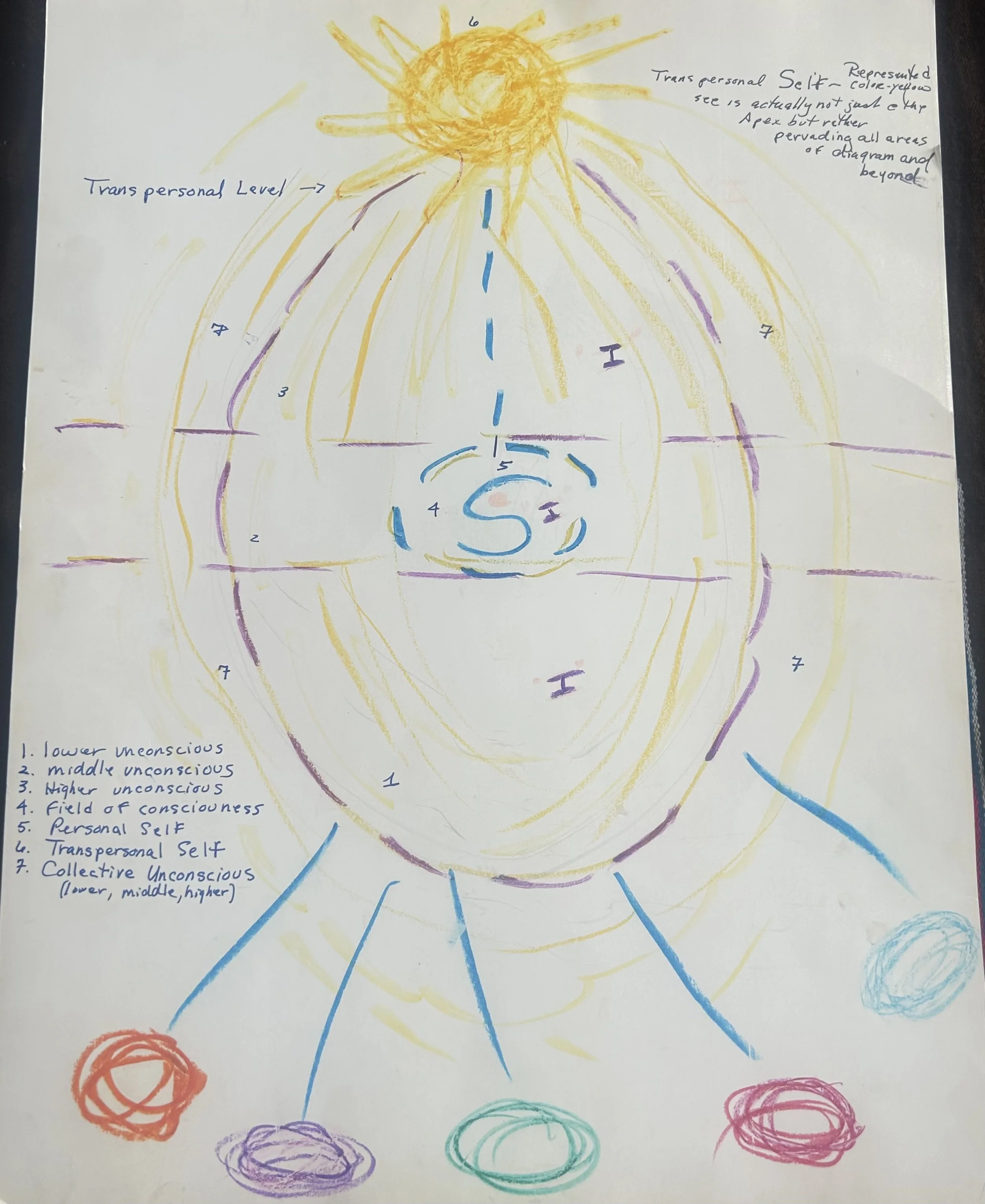
A Map of Consciousness
One of the most helpful tools in Psychosynthesis is Assagioli's Egg Model, a map of consciousness that helps us understand the many layers of our inner world.
Rather than viewing people as broken or disordered, Assagioli saw human beings as complex, dynamic, and capable of tremendous growth.
The Egg Model reminds us that there is far more to us than what we are consciously aware of at any given moment.
It offers a way of understanding where our wounds live, where our gifts emerge, and how we can access a deeper relationship with ourselves.
The Lower Unconscious
The Lower Unconscious contains aspects of ourselves that have been pushed out of awareness.
This may include:
Old wounds
Fears
Limiting beliefs
Survival strategies
Unprocessed emotions
Protective patterns
These aspects are not bad.
In fact, many of them developed to help us survive difficult experiences.
The goal is not to eliminate these parts of ourselves.
The goal is to bring them into awareness so they can be understood, healed, and integrated.
The Middle Unconscious
The Middle Unconscious contains the aspects of ourselves that make up our everyday experience.
This includes:
Relationships
Work
Responsibilities
Habits
Memories
Personal identity
Most people spend the majority of their lives operating from this level of consciousness.
It is where we navigate the practical realities of being human.
The Higher Unconscious
The Higher Unconscious contains our untapped potential and our connection to something greater.
This may include:
Intuition
Creativity
Inspiration
Wisdom
Purpose
Spiritual insight
Moments of profound connection
Many spiritual experiences emerge from this level of consciousness.
It reminds us that healing is not only about working through our wounds—it is also about awakening our gifts.
The Self
At the center of the Egg Model is The Self.
The Self is not a role, personality, or identity.
It is the observing awareness that remains present throughout all of life's experiences.
Thoughts come and go.
Emotions come and go.
Roles and identities change.
The Self remains.
The Self is the part of us that can notice:
"I am feeling afraid."
instead of:
"I am fear."
Or:
"A part of me is hurting."
instead of:
"I am broken."
This ability to observe without becoming consumed is one of the foundations of healing.
Disidentification
One of Assagioli's most important teachings is the practice of disidentification.
Disidentification does not mean detachment or avoidance.
It simply means recognizing that we are more than any single thought, emotion, wound, or role.
We have emotions.
We are not our emotions.
We have parts.
We are not our parts.
We have experiences.
We are not our experiences.
As awareness expands, we gain greater freedom in how we respond to life.
Why This Matters
The Egg Model helps us understand that healing involves more than working through pain.
It involves integrating all aspects of ourselves.
The wounded parts.
The protective parts.
The gifted parts.
The intuitive parts.
The forgotten parts.
As we learn to relate to each of these aspects with curiosity and compassion, we move toward greater wholeness.
Key Teaching
You have parts. You are not your parts.
You have emotions. You are not your emotions.
Healing begins when awareness becomes larger than the experience.
Reflection Questions
Which area of the Egg Model feels most familiar to you right now?
What protective patterns have helped you survive?
What gifts or qualities might be waiting within your Higher Unconscious?
How would your life change if you remembered that you are more than any single role, thought, or emotion?
-
Subpersonalities, Survival Strategies & the Journey Away From Ourselves
One of the core ideas shared by both Psychosynthesis and Shamanism is that we begin life in a state of wholeness.
As children, we are naturally curious, creative, emotional, intuitive, and connected to ourselves. We express joy freely. We cry when we are sad. We trust our instincts. We move through life without constantly questioning our worth.
Yet as we grow, we begin adapting to the world around us.
We learn what is accepted.
We learn what is rejected.
We learn which parts of ourselves feel safe to express and which parts feel safer to hide.
Little by little, we begin shaping ourselves in response to our experiences.
This is not a mistake.
It is a survival strategy.
Learning to Belong
Every family, culture, school, and community has spoken and unspoken rules.
As children, our deepest need is often belonging.
We quickly learn:
Which emotions are welcome
Which emotions create discomfort
What earns approval
What invites criticism
How to stay connected
How to stay safe
Perhaps you learned that being helpful earned praise.
Perhaps achievement brought attention.
Perhaps staying quiet prevented conflict.
Perhaps taking care of everyone else helped you feel needed.
These adaptations are intelligent responses to the environments in which we grow.
The problem is not that we adapted.
The problem is that many of these strategies continue long after they are no longer necessary.
The Birth of Subpersonalities
Psychosynthesis uses the term subpersonality to describe the parts of ourselves that develop around these adaptations.
You can think of subpersonalities as inner characters, each with its own beliefs, motivations, fears, and protective strategies.
Every subpersonality has a positive intention.
Each one emerged to help us navigate life.
Some common examples include:
The Caretaker
The part that takes care of everyone else.
The Caretaker believes love is earned through service and support.
It is generous and compassionate, but often struggles to receive help itself.
The Pleaser
The part that seeks safety through approval.
The Pleaser avoids conflict, monitors the needs of others, and often sacrifices authenticity in order to maintain harmony.
The Performer
The part that believes worth must be earned.
The Performer seeks achievement, success, and recognition as a way of feeling valuable.
Beneath the ambition is often a fear that simply being is not enough.
The Controller
The part that tries to create safety through certainty.
The Controller believes that if everything can be planned, managed, or predicted, pain can be avoided.
The Rescuer
The part that feels responsible for the wellbeing of others.
The Rescuer wants to help, heal, and fix.
Its intentions are often beautiful, but it may forget that every person's healing journey belongs to them.
The Victim
The part that carries pain, disappointment, fear, or helplessness.
The Victim often feels powerless and may struggle to recognize its own capacity for choice and transformation.
Every Part Has Wisdom
One of the most compassionate teachings in Psychosynthesis is that no part of us is bad.
Every protective pattern developed for a reason.
The Pleaser protected belonging.
The Performer protected worth.
The Controller protected safety.
The Caretaker protected connection.
The Rescuer protected against helplessness.
The Victim protected pain.
These parts are not problems to eliminate.
They are aspects of ourselves asking to be understood.
Healing begins when we stop judging these parts and start listening to them.
Fragmentation & Soul Loss
Over time, as certain parts become stronger, other parts of ourselves may fade into the background.
The playful child.
The creative dreamer.
The intuitive knower.
The joyful spirit.
The authentic voice.
We do not lose these parts.
We simply lose contact with them.
Psychosynthesis describes this as fragmentation.
Shamanic traditions often describe it as soul loss.
Different language.
Same journey.
In both traditions, healing involves restoring relationship with the aspects of ourselves that have been forgotten, hidden, or abandoned.
The Path Back to Wholeness
The goal of healing is not perfection.
The goal is integration.
We are not trying to get rid of our parts.
We are learning to recognize them, understand them, and bring them into conscious relationship with the Self.
As awareness grows, our protective strategies no longer have to run our lives.
We gain the freedom to choose rather than react.
We gain the freedom to live from authenticity rather than survival.
And we begin remembering the wholeness that has been present all along.
Key Teaching
Every defense mechanism was once trying to protect you.
Adaptation is not pathology.
The goal is not to eliminate our parts.
The goal is to understand them, integrate them, and bring them home.
Reflection Questions
Which subpersonality do you recognize most strongly within yourself?
What positive intention might that part have been trying to fulfill?
How has that part supported you throughout your life?
What parts of yourself feel forgotten or disconnected?
What would it feel like to meet your protective parts with compassion rather than criticism?
-
Bringing Ourselves Home
As we explored in the previous section, life has a way of shaping us.
Through loss, disappointment, trauma, fear, and the desire to belong, we often learn to hide parts of ourselves in order to feel safe.
Over time, we may find ourselves feeling disconnected from who we truly are.
Many people describe this experience by saying:
"I don't feel like myself anymore."
Or:
"I feel like I've lost a part of myself."
In shamanic traditions, this experience is often referred to as soul loss.
Soul loss does not mean the soul is gone.
It simply means that aspects of our vitality, creativity, joy, innocence, authenticity, or personal power have become disconnected from our conscious awareness.
Psychosynthesis describes a similar process through the language of fragmentation and disowned parts of self.
Different language.
Same journey.
Remembering What Was Never Lost
One of the most beautiful teachings of Soul Retrieval is that healing is not about becoming someone new.
It is about remembering.
Remembering the parts of yourself that were forgotten.
Reclaiming the gifts that were hidden.
Welcoming home the aspects of yourself that learned it was safer to stay in the background.
The playful child.
The creative dreamer.
The intuitive knower.
The courageous heart.
These parts are not gone.
They are waiting to be remembered.
The Journey Home
Soul Retrieval is ultimately a process of reconnection.
It is the gradual restoration of relationship with the parts of ourselves that long to be seen, loved, and integrated.
This journey is not about fixing what is broken.
It is about returning to wholeness.
Returning to authenticity.
Returning to yourself.
Key Teaching
Healing is not becoming someone new.
Healing is remembering who you have always been.
The soul was never lost.
The relationship simply needs to be restored.
Reflection Questions
What part of yourself feels ready to come home?
What qualities or gifts do you long to reconnect with?
What would it feel like to trust that your wholeness has never been lost?
-
The Wisdom of Shedding
In the Andean tradition, Serpent is the first archetype we encounter on the medicine wheel.
This is not accidental.
Most people imagine spiritual growth as a process of becoming more. More aware. More intuitive. More enlightened. More connected.
Yet Serpent teaches us that transformation begins differently.
Before we can become more, we must first learn how to let go.
Before we can receive, we must create space.
Before we can rise, we must release.
Why Serpent Comes First
A snake sheds its skin when it can no longer grow within it.
The skin is not bad.
The skin served a purpose.
It protected.
It supported growth.
It helped the snake survive.
Yet eventually it becomes too small.
Too restrictive.
Too limiting.
And what once supported life begins preventing further growth.
The same thing happens within us.
Throughout our lives we develop identities, beliefs, expectations, habits, and ways of being that help us navigate the world.
Some of these patterns serve us beautifully for a season.
Yet eventually growth asks us a difficult question:
Can you release what no longer fits?
Identity Is Not Essence
One of the most powerful teachings of Serpent medicine is learning the difference between who we are and the roles we play.
We may identify as:
Mother
Daughter
Partner
Therapist
Teacher
Healer
Caregiver
Business Owner
These roles matter.
They shape our experience.
But they are not the entirety of who we are.
When we become overly attached to an identity, we may begin limiting ourselves without realizing it.
Serpent reminds us that identities change.
Life changes.
We change.
Our essence remains.
The journey is learning to release identification with what is temporary and reconnect with what is eternal.
What Skin Has Become Too Tight?
This is one of the central questions of Serpent medicine.
Not:
Who should I become?
But:
What am I being asked to release?
Perhaps it is a belief.
Perhaps it is an old story.
Perhaps it is a relationship.
Perhaps it is an expectation.
Perhaps it is a version of yourself that no longer reflects who you are becoming.
Growth often begins with noticing where life feels constricted.
Where something no longer fits.
Where a deeper truth is asking to emerge.
Humility & Surrender
Serpent also teaches humility.
In many indigenous traditions, humility is not about making ourselves small.
It is about remembering our place within something larger.
Grace often speaks about putting your forehead on the Earth.
Not as an act of submission.
As an act of remembrance.
A remembrance that we are not separate from life.
Not separate from Spirit.
Not separate from Pachamama.
The more we try to control everything, the more suffering we often create.
The more we learn to listen, trust, and participate in the natural unfolding of life, the more harmony becomes possible.
The Great Surrender
Most of us spend our lives trying to create certainty.
We want to know what will happen.
We want guarantees.
We want assurance that things will unfold according to our plans.
Life rarely works that way.
At some point, every one of us encounters experiences that cannot be controlled.
Loss.
Change.
Grief.
Uncertainty.
Heartbreak.
Transformation.
Serpent teaches us that surrender is not giving up.
Surrender is allowing life to move through us without insisting that it conform to our expectations.
It is trusting the process even when we cannot see the outcome.
It is remaining open when the old skin is falling away and the new one has not yet fully emerged.
The Invitation of Serpent
The invitation of Serpent is simple.
Pay attention to what is ready to be released.
Notice where you are holding on.
Notice what no longer fits.
Notice the stories, identities, fears, and expectations that may be preventing your growth.
Then ask yourself:
What would happen if I trusted the process?
What would happen if I loosened my grip?
What would happen if I allowed myself to shed?
Transformation rarely begins with force.
More often, it begins with surrender.
Key Teaching
Before we rise, we must release.
Growth requires shedding.
Identity is not essence.
Surrender is not giving up.
Surrender is trusting life enough to let it change you.
Reflection Questions
What skin has become too tight in your life?
What role, identity, or belief are you being asked to release?
Where are you holding on more tightly than necessary?
What would trust look like in this season of your life?
What is Serpent asking you to shed?
-
Hucha, Energetic Density & the Cost of Holding On
Why Shedding Matters
One of the questions that often arises when discussing surrender is:
What happens when we don't let go?
What happens when we continue holding onto identities that no longer fit?
What happens when grief remains unprocessed?
What happens when fear begins making our decisions?
What happens when old stories become more important than truth?
The Andean tradition offers a framework for understanding this through the concept of Hucha.
Understanding Hucha
Throughout this training, you'll hear the words Hucha and Sami used frequently.
These concepts come from the Quechua-speaking wisdom traditions of the Andes and describe two qualities of living energy, or Kawsay.
Hucha refers to dense, heavy, or stagnant energy.
Sami refers to refined, nourishing, and harmonious energy.
It is important to understand that Hucha is not considered bad.
This is one of the most common misunderstandings people have when first encountering these teachings.
Hucha is simply energy that has become heavy.
Just as compost eventually becomes nourishment for a garden, Hucha can be transformed.
Nothing is wasted.
Nothing is inherently wrong.
Everything can be returned to balance.
We All Accumulate Hucha
As human beings, we naturally accumulate energetic density.
Every disappointment.
Every grief.
Every resentment.
Every fear.
Every attachment.
Every unspoken truth.
Every experience we refuse to feel.
Every identity we cling to after it has outlived its purpose.
All of these contribute to energetic heaviness.
This is not failure.
It is part of being human.
The question is not whether we accumulate Hucha.
The question is whether we learn how to work with it.
When Energy Stops Moving
Nature teaches us an important principle:
Life depends upon movement.
Water moves.
Seasons change.
Trees shed leaves.
Animals migrate.
Cells regenerate.
The breath itself depends upon continual exchange.
Everything in nature participates in cycles of release and renewal.
Human beings are no different.
When we resist change, energy begins to stagnate.
When we refuse to grieve, energy stagnates.
When we cling to outdated identities, energy stagnates.
When fear becomes rigid, energy stagnates.
When resentment remains unresolved, energy stagnates.
Over time, this accumulation creates constriction.
Not only emotionally.
Not only spiritually.
But often physically as well.
The Example of Aging
Many of us have witnessed people become increasingly rigid as they grow older.
Perhaps you've seen someone become attached to possessions they no longer need.
Attached to stories they tell repeatedly.
Attached to identities they can no longer release.
Attached to ways of being that no longer support them.
The issue is not age.
The issue is flexibility.
Life continues inviting us to evolve.
When we stop responding to that invitation, density accumulates.
The body often begins carrying what the psyche refuses to release.
This is one reason spiritual traditions place such importance on forgiveness, grieving, ceremony, prayer, reflection, and surrender.
These practices help restore movement.
Serpent as Medicine for Hucha
This brings us back to Serpent.
The medicine of Serpent is not simply surrender for surrender's sake.
Serpent teaches us how to keep energy moving.
How to release before rigidity develops.
How to shed before constriction becomes suffering.
How to trust life enough to let transformation occur naturally.
Every time we release an identity that no longer fits, energy moves.
Every time we tell the truth, energy moves.
Every time we grieve, energy moves.
Every time we forgive, energy moves.
Every time we surrender control, energy moves.
And where energy moves, healing becomes possible.
A Different Relationship with Change
Many people approach change with fear.
The Serpent approaches change differently.
The Serpent understands that release is part of life.
Nothing remains the same forever.
Not our bodies.
Not our relationships.
Not our roles.
Not our beliefs.
Not even our understanding of ourselves.
The invitation is not to resist change.
The invitation is to participate in it consciously.
To trust that what is leaving may be creating space for something new.
To recognize that surrender is not loss.
It is part of life's natural rhythm.
Reflection Questions
Where in your life do you notice rigidity or resistance to change?
What emotions feel difficult for you to process or express?
Are there identities, stories, or beliefs you continue carrying that no longer fit who you are becoming?
What helps energy move through your system in healthy ways?
How do you typically respond when life asks you to let go?
What might become possible if you trusted change rather than feared it?
Where is Serpent inviting you to shed something in this season of your life?
-
Victim, Rescuer & Persecutor
One of the most useful tools I have encountered for understanding human behavior is something called the Drama Triangle.
At first glance, it appears simple.
In reality, it can completely change the way we see ourselves, our relationships, and the unconscious patterns that keep us stuck.
The Drama Triangle describes three roles we unconsciously move between when we become disconnected from our power:
Victim
Rescuer
Persecutor
Most people believe they primarily occupy one role.
In reality, we tend to move between all three.
The triangle is dynamic.
A Victim becomes a Rescuer.
A Rescuer becomes a Persecutor.
A Persecutor becomes a Victim.
Without awareness, we can spend years moving between these roles while believing our suffering is being caused entirely by other people.
The Victim
The Victim believes:
"I have no power."
"Life is happening to me."
"Someone else needs to fix this."
It is important to understand that being in Victim consciousness is not the same thing as experiencing pain.
Life brings real loss.
Real grief.
Real disappointment.
Real trauma.
The issue is not the pain itself.
The issue is believing we have no agency within our experience.
Victim consciousness often sounds like:
Why does this always happen to me?
Nothing ever changes.
I can't.
It's hopeless.
Someone needs to help me.
When we live in Victim consciousness, we unknowingly give our power away.
The Rescuer
Most people who are drawn to healing work immediately recognize the Rescuer.
The Rescuer wants to help.
The Rescuer wants to heal.
The Rescuer wants to save everyone.
This role often sounds like:
"If I can just help enough people, everything will be okay."
"It's my responsibility to make sure everyone is alright."
"I know what they need."
The Rescuer usually has a beautiful heart.
The intention is rarely harmful.
But rescuing often comes at a cost.
We begin carrying burdens that do not belong to us.
We become responsible for other people's healing.
Other people's happiness.
Other people's choices.
Other people's growth.
Eventually we become exhausted.
Resentful.
Overextended.
The spiritual lesson of the Rescuer is learning the difference between service and responsibility.
You can support someone without carrying them.
You can love someone without saving them.
You can hold space without fixing.
The Persecutor
The Persecutor attempts to create safety through control.
This role often appears as:
blame
criticism
judgment
anger
perfectionism
defensiveness
Underneath the Persecutor is usually fear.
Fear of vulnerability.
Fear of uncertainty.
Fear of losing control.
The Persecutor believes:
"If everyone would just do what they're supposed to do, everything would be fine."
The challenge is that control rarely creates peace.
It often creates distance.
The more tightly we attempt to control life, the more suffering we tend to experience.
Why We Move Around the Triangle
The fascinating thing about the Drama Triangle is that nobody stays in one role for very long.
Imagine someone constantly rescuing a friend.
Eventually they become frustrated because the friend isn't changing.
Now the Rescuer becomes the Persecutor:
"Why won't you listen to me?"
Then the friend responds:
"You're being unfair."
Now the Persecutor becomes the Victim.
And around the triangle we go.
The roles change.
The pattern remains.
The Wounded Healer
One of the reasons this teaching is so important is because many of us were drawn to healing work from our own experiences of suffering.
We know what it feels like to hurt.
We know what it feels like to struggle.
We know what it feels like to search for answers.
This can create tremendous compassion.
It can also create a tendency to rescue.
Many healers unconsciously believe:
"If I can heal everyone else, maybe I won't have to feel my own pain."
This is not something to judge.
It is simply something to become aware of.
Awareness is where freedom begins.
Moving Beyond the Triangle
The goal is not to become a better Victim.
A better Rescuer.
Or a better Persecutor.
The goal is to step off the triangle entirely.
When we step off the triangle:
Instead of Victim, we choose responsibility.
Instead of Rescuer, we choose support.
Instead of Persecutor, we choose compassion.
We stop trying to control.
We stop trying to save.
We stop believing we are powerless.
And we begin responding consciously to life.
Reflection Questions
Which role do you find yourself entering most often?
What benefit does that role provide?
What cost does it create?
Where are you carrying responsibility that does not belong to you?
What would healthy support look like instead of rescue?
What would change if you trusted others to walk their own path?
-
As Serpent teaches us to shed, Jaguar teaches us to face what remains.
In the next module, we will explore fear, shadow, courage, and transformation.
Jaguar invites us into the places we often avoid.
The uncomfortable places.
The uncertain places.
The hidden places.
Not to punish us.
Not to overwhelm us.
But to help us discover that we are stronger, wiser, and more resilient than we imagine.
Before we can walk with Jaguar, we must first learn to release what no longer serves us.
That is the gift of Serpent.
And that is the work you have begun here.
Take your time.
Be gentle with yourself.
And trust the process.
The journey has only just begun.
Serpent Reflection Questions
What skin has become too tight?
What identity are you being asked to release?
Which subpersonality do you recognize most strongly?
What part of yourself is asking to come home?
Where has Hucha accumulated in your life?
What role do you most often occupy in the Drama Triangle?
What would surrender look like right now?
What intention are you carrying into Jaguar?
Module 1 Tools
Serpent Meditation Journey
Find a quiet space where you can relax without interruption. Have your journal, drawing paper, and pastels nearby.
This 18-minute guided journey is designed to help you deepen your relationship with Witness "I" Consciousness and Serpent Medicine throughout Module One. Feel free to return to this meditation as often as you'd like.
After listening, you are invited to journey on your own using a drum or rattle. Spend time with Serpent and Witness Consciousness, allowing any messages, images, symbols, colors, sensations, or insights to arise naturally.
When complete, journal and/or draw your experience. Label your entry:
"I & Serpent Journey"
This will help you track your experiences and reflections throughout the module.
🌿🐍
Prayer for Opening (And Closing Sacred Space)
Assagioli’s Egg Model