Module Two: Jaguar - The Path of Courage, Shadow & Transformation 🐆 💫
Expand each ‘plus sign to find the information for each module. Notes will be added and updated as the course continues. Thank you for being here!
-
As we move from Serpent into Jaguar, we enter a new phase of the journey.
Serpent asked us to shed.
To release identities, attachments, beliefs, and stories that no longer serve us.
Jaguar asks something different.
Jaguar asks:
What happens after the shedding?
Because once the skin falls away, there is often a period of uncertainty.
The old self is gone.
The new self has not fully arrived.
And it is here that fear emerges.
This is Jaguar's territory.
In the Andean tradition, Jaguar is the archetype that sees in the dark.
While others become consumed by fear, Jaguar remains present.
While others turn away from what is uncomfortable, Jaguar moves closer.
While others focus on appearances, Jaguar tracks what lies beneath them.
Jaguar teaches us to see beyond behavior and into the deeper truth beneath it.
To see beyond the story.
To see beyond the defense.
To see beyond the mask.
This is why Jaguar is often associated with shadow work.
Not because Jaguar is interested in darkness for its own sake, but because Jaguar is willing to go where others refuse to look.
Seeing Beyond Behavior
Most people react to behavior.
Someone becomes angry.
Someone withdraws.
Someone criticizes.
Someone becomes controlling.
Someone seeks constant approval.
Someone shuts down emotionally.
Most people stop there.
Jaguar does not.
Jaguar asks:
What fear is beneath that behavior?
What wound is trying to protect itself?
What survival strategy is operating right now?
The behavior is rarely the whole story.
Behavior is often the protective layer covering something more vulnerable underneath.
When we learn to see beneath the surface, our relationship with ourselves and others begins to change.
We become less reactive.
More compassionate.
More curious.
More conscious.
Fear Is Jaguar's Territory
One of the greatest misconceptions about courage is that courageous people are not afraid.
This is not true.
Courageous people feel fear.
They simply do not allow fear to make their decisions.
Jaguar teaches us that fear is a natural part of transformation.
In fact, fear is often a sign that growth is occurring.
When we step beyond familiar identities and familiar patterns, fear naturally arises.
The unknown always activates the part of us that wants certainty.
The part that wants guarantees.
The part that wants to know exactly how everything will unfold before taking a step forward.
Yet growth rarely works that way.
Jaguar asks us to trust the next step before the entire path is visible.
The Unknown
Throughout this module, we will return again and again to the idea of the unknown.
Most people believe they are afraid of failure.
In reality, they are often afraid of uncertainty.
People remain in jobs that no longer fulfill them.
They remain in relationships that have run their course.
They continue repeating familiar patterns.
Not because they want to.
But because the familiar feels safer than the unknown.
Even when the familiar is painful.
Jaguar invites us to question that habit.
What if the unknown is not something to fear?
What if the unknown is where life is trying to lead us?
What if the next version of ourselves exists just beyond the place we are afraid to enter?
Jaguar Medicine
Jaguar is not reckless.
Jaguar is not impulsive.
Jaguar is deeply present.
Deeply aware.
Deeply attuned.
The Jaguar path is not about forcing ourselves through fear.
It is about learning how to remain present while fear is present.
To continue walking.
To continue listening.
To continue trusting.
Even when we cannot yet see the destination.
This is the medicine of Jaguar.
Reflection Questions
What am I currently afraid to face?
Where am I being asked to trust the unknown?
What behavior am I focusing on instead of the deeper wound beneath it?
What would change if I became curious rather than reactive?
What would Jaguar see that I am currently avoiding?
Key Teaching
Jaguar sees beyond the behavior and tracks the wound beneath it.
Courage is not the absence of fear.
Courage is walking forward anyway.
-
The Observer, The Will & The Journey Toward Wholeness
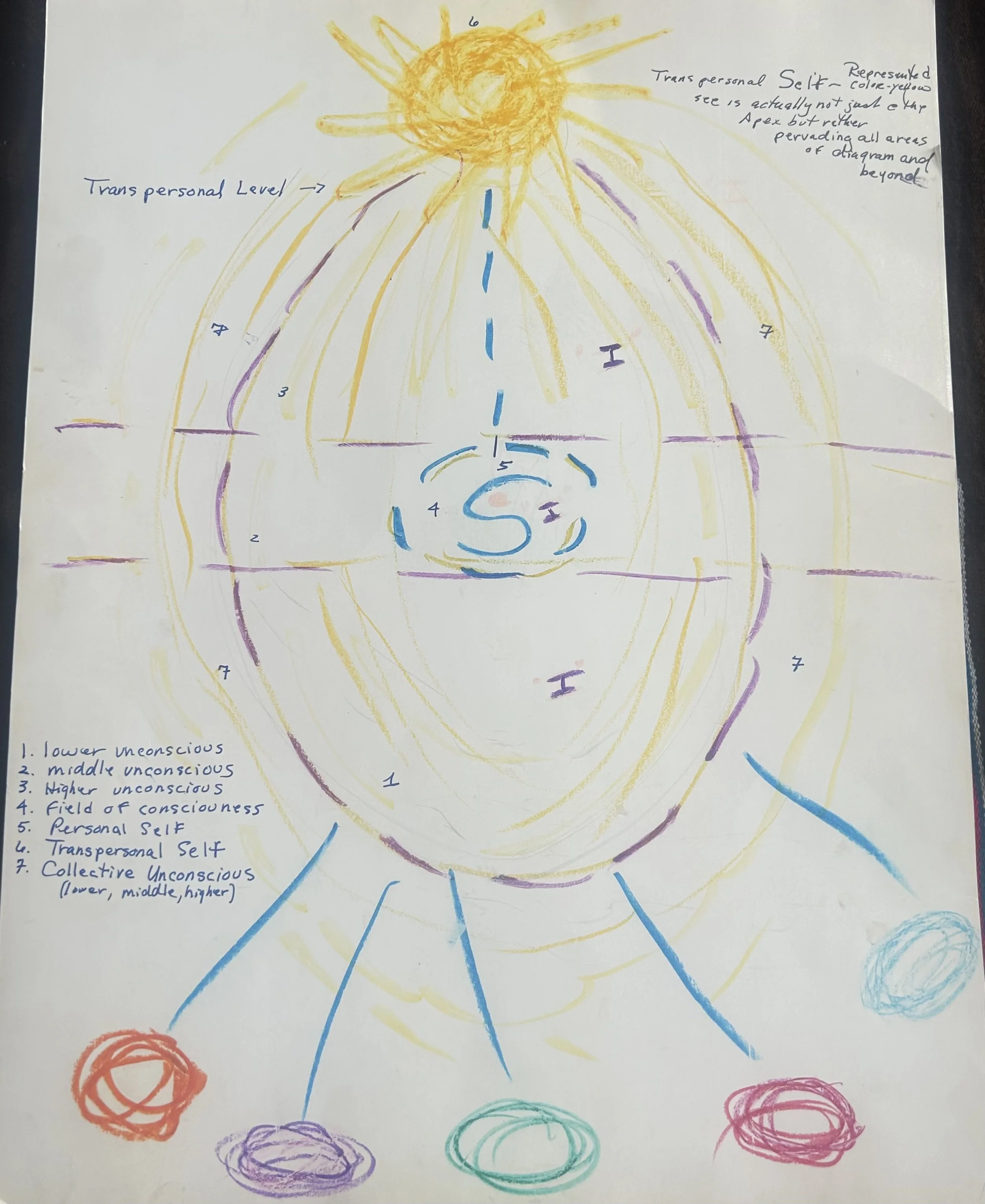
In Module One, we introduced Roberto Assagioli's Egg Model as a map of consciousness. As we move into Jaguar territory, we revisit this model through a different lens.
Serpent helped us identify what is ready to be shed.
Jaguar asks us to look more closely at what created those identities in the first place.
To do this, we need a deeper understanding of consciousness and how we relate to our thoughts, emotions, fears, and protective patterns.
We Are More Than What We Experience
One of Assagioli's most important teachings is that we are not our thoughts.
We are not our emotions.
We are not our fears.
We are not our wounds.
We are not our subpersonalities.
We have all of these experiences, but they do not define the totality of who we are.
Most suffering occurs when we become identified with a particular experience and forget that there is a deeper awareness capable of observing it.
This is where the Observer becomes important.
The Observer Self
The Observer, sometimes called the Witness, is the part of us that can step back and notice what is happening without becoming consumed by it.
The Observer notices:
Thoughts
Emotions
Reactions
Sensations
Behaviors
Patterns
Without judgment.
Without criticism.
Without needing to fix anything.
The Observer simply sees.
When we access the Observer, we create space between ourselves and our experience.
Instead of saying:
I am angry.
We begin saying:
I notice anger.
Instead of:
I am afraid.
We begin saying:
I notice fear.
Instead of:
I am broken.
We begin saying:
A part of me is hurting.
This subtle shift changes everything.
Identification vs. Observation
Grace often says:
The moment you identify with it, it's over.
What does this mean?
When we identify with a thought, emotion, or subpersonality, we become fused with it.
The experience takes over.
The fear becomes our reality.
The reaction becomes automatic.
The wound begins making decisions for us.
At that moment, we lose access to choice.
We are no longer responding consciously.
We are reacting.
Jaguar invites us to remain present long enough to notice what is happening before we become it.
The Role of the Will
Another important aspect of Assagioli's model is the concept of the Will.
Many people misunderstand the Will as force or control.
In Psychosynthesis, the Will is something different.
The Will is our capacity to choose.
To direct attention.
To make conscious decisions.
To align our actions with our deeper values.
The Will is what allows us to respond rather than react.
Without the Will, we remain at the mercy of old patterns.
With the Will, we gain the ability to pause, reflect, and choose a different path.
The Limbic Brain & Survival
When we experience a threat—real or perceived—the limbic brain becomes activated.
The limbic brain is concerned with one thing:
Survival.
It responds through familiar patterns such as:
Fight
Flight
Freeze
Fawn
These responses are not bad.
They are intelligent survival mechanisms.
The problem occurs when old survival strategies continue operating long after the original threat has passed.
As adults, we often find ourselves reacting to present-day situations through the lens of past experiences.
This is where many of our subpersonalities emerge.
Why Meditation Matters
Grace explains that meditation helps strengthen the Observer.
The more we practice witnessing our thoughts and emotions without becoming entangled in them, the easier it becomes to remain centered when challenges arise.
Meditation creates space.
Space creates awareness.
Awareness creates choice.
Choice creates transformation.
Without awareness, we continue repeating the same patterns unconsciously.
With awareness, we begin responding from a deeper place.
The Loving Witness
One of the easiest ways to know whether you are truly in Observer Consciousness is to notice the quality of your attention.
The Observer is:
Compassionate
Curious
Patient
Present
Non-judgmental
If criticism appears, another subpersonality has likely stepped in.
If shame appears, another part is likely speaking.
If blame appears, another voice has entered the conversation.
The Observer does not attack.
The Observer witnesses.
The Observer understands.
The Observer creates the safety necessary for healing to occur.
Why This Matters for Jaguar
Jaguar cannot track what we refuse to see.
The Observer allows us to see.
It allows us to step back from our reactions and begin exploring what lies beneath them.
This is the beginning of shadow work.
This is the beginning of transformation.
Before we can heal a wound, we must be willing to observe it.
Before we can transform a pattern, we must become aware of it.
Before we can reclaim lost aspects of ourselves, we must be willing to look into the darkness with open eyes.
This is Jaguar's invitation.
Reflection Questions
What thoughts or emotions do you most easily identify with?
What changes when you shift from "I am" to "I notice"?
What situations make it difficult for you to remain in Observer Consciousness?
How do you know when a subpersonality has taken over?
What would it feel like to meet yourself with greater curiosity and compassion?
Key Teaching
You are not your thoughts.
You are not your emotions.
You are not your wounds.
You are the awareness capable of witnessing them.
The moment you identify with it, it takes over.
The moment you observe it, transformation becomes possible.
-
The Wounded Child & The Defensive Child
One of the most important teachings in Psychosynthesis is the understanding that every person develops different aspects of their personality in response to life experiences.
These aspects are often referred to as subpersonalities.
While the term may sound complex, the idea itself is simple.
Every subpersonality began as an attempt to protect us.
We All Arrive Vulnerable
When we enter the world, we are completely dependent on others.
We are sensitive.
Open.
Vulnerable.
We do not yet have the ability to reason, analyze, or understand our experiences the way adults do.
Instead, we interpret life through feeling.
Through relationship.
Through belonging.
And because of this vulnerability, even seemingly small experiences can leave a powerful imprint.
A child may conclude:
Something is wrong with me.
I am not enough.
I am not safe.
I am unlovable.
I do not belong.
My needs are too much.
Whether those beliefs are objectively true is not the point.
What matters is that they become real within the child's experience.
The Wound
At some point, every human being experiences some form of wounding.
This is not a failure.
It is part of being human.
No one escapes life without disappointment.
Without loss.
Without rejection.
Without misunderstanding.
Without moments that leave us questioning our value or our place in the world.
When these experiences occur, a wound is created.
The wound itself is vulnerable.
Tender.
Exposed.
Painful.
Naturally, the psyche seeks protection.
The Adaptation
Once a wound occurs, the personality begins adapting.
The psyche asks:
How do I make sure this never happens again?
This adaptation becomes a protective strategy.
It develops with the best of intentions.
Its purpose is survival.
Its purpose is safety.
Its purpose is protection.
This is the beginning of a subpersonality.
The Wounded Child & The Defensive Child
Grace often describes this process through two parts:
The Wounded Child
The wounded child carries the original hurt.
The sadness.
The fear.
The rejection.
The shame.
The grief.
Because these feelings can be overwhelming, the wounded child often retreats into the shadow for safekeeping.
Not because it is bad.
Because it is vulnerable.
The Defensive Child
The defensive child develops in response to the wound.
Its job is protection.
Its job is making sure the wound is never experienced again.
The defensive child may become:
A Pleaser
A Performer
A Caretaker
A Controller
An Avoider
A Perfectionist
A Rescuer
Each strategy serves the same purpose:
Keep me safe.
Every Subpersonality Has a Positive Intention
This is one of the most important ideas in this work.
No subpersonality was created to hurt you.
Every subpersonality was created to help you.
Even the parts that create difficulty in your life today.
The Controller wants safety.
The Pleaser wants connection.
The Performer wants worthiness.
The Rescuer wants love.
The Avoider wants protection.
The Perfectionist wants approval.
When we understand this, we stop viewing our patterns as enemies.
Instead, we begin relating to them with curiosity and compassion.
Why These Patterns Continue
The challenge is that these adaptations were often created during childhood.
The problem they were designed to solve may no longer exist.
Yet the strategy remains.
The child grows up.
The pattern stays.
And because the strategy once worked, it continues operating automatically.
Many of our reactions in adulthood are not actually about the present moment.
They are old protective strategies responding to current situations.
This is why certain experiences can feel disproportionately painful.
They are not simply activating today's emotions.
They are touching something much older.
Triggering the Wound
When people say:
"I got triggered."
What often happened is that an old wound was activated.
The wound rises to the surface.
The defensive child quickly follows.
And before we know it, we are reacting rather than responding.
This is not failure.
It is information.
The trigger is showing us where healing is still needed.
The Gift Hidden Within Every Part
One of the beautiful aspects of this work is recognizing that every subpersonality carries gifts.
The goal is not to eliminate the part.
The goal is to transform our relationship with it.
For example:
The Controller
Shadow:
Rigidity
Micromanagement
Fear of uncertainty
Gift:
Organization
Leadership
Responsibility
The Pleaser
Shadow:
Self-abandonment
Lack of boundaries
Gift:
Empathy
Compassion
Sensitivity
The Performer
Shadow:
Overachievement
Burnout
Gift:
Motivation
Creativity
Excellence
Every part contains wisdom.
Every part contains medicine.
The Jaguar Invitation
Jaguar invites us to stop asking:
What's wrong with me?
And begin asking:
What is this part trying to protect?
This shift changes everything.
Because healing is not about defeating our defenses.
Healing is about understanding them.
Listening to them.
And eventually helping them evolve beyond the roles they were created to perform.
Reflection Questions
Which defensive strategies do you recognize most strongly in yourself?
What might those parts be trying to protect?
What wound sits beneath those behaviors?
What gifts might be hidden within those parts?
How would your relationship with yourself change if you viewed these patterns with compassion instead of judgment?
Key Teaching
Every subpersonality was created to serve you.
Every defense began as protection.
Every wound carries wisdom.
Healing begins when we stop fighting our parts and start listening to them.
🌿🐆
-
Meeting the Parts of Ourselves with Compassion
Once we begin recognizing our subpersonalities, a new question emerges:
Now what?
Many people believe healing happens by getting rid of unwanted behaviors.
We want to eliminate fear.
Eliminate insecurity.
Eliminate people pleasing.
Eliminate self-doubt.
Eliminate anger.
Yet the Jaguar path teaches something different.
Healing does not happen through rejection.
Healing happens through relationship.
What Is Shadow Work?
The shadow is often misunderstood.
Many people hear the word shadow and immediately think of darkness, negativity, or something dangerous.
In reality, the shadow simply refers to aspects of ourselves that have been pushed outside of conscious awareness.
These may include:
Fears
Vulnerabilities
Unexpressed emotions
Hidden gifts
Unmet needs
Rejected aspects of self
The shadow is not bad.
The shadow is simply what has not yet been fully seen.
Jaguar teaches us how to look at these hidden places without turning away.
Why We Hide Parts of Ourselves
As children, we quickly learn which parts of ourselves are welcomed and which parts feel unsafe to express.
Perhaps we learned:
Don't be angry.
Don't be needy.
Don't be emotional.
Don't take up too much space.
Don't disappoint others.
Don't fail.
Over time, these aspects of ourselves get pushed into the background.
They don't disappear.
They simply go underground.
And from the shadow, they continue influencing our lives.
Often without us realizing it.
The Goal Is Not Elimination
One of the most important teachings in this work is that we are not trying to get rid of our subpersonalities.
We are not trying to get rid of our wounded parts.
We are not trying to get rid of our fears.
We are trying to understand them.
Every part exists for a reason.
Every part has a story.
Every part developed in service to something important.
When we stop judging these parts, they begin to reveal what they have been trying to protect all along.
The Loving Witness
Healing begins when we learn to approach our inner world from the Observer rather than from another wounded part.
Grace describes the Observer as:
Loving
Compassionate
Curious
Present
Non-judgmental
This is important.
Because sometimes we believe we are observing ourselves when we are actually criticizing ourselves.
For example:
"Why am I still doing this?"
"I should know better."
"What's wrong with me?"
These are not the voice of the Observer.
These are other subpersonalities speaking.
The Observer does not attack.
The Observer listens.
Reparenting the Parts
Many of the wounded parts within us never received what they truly needed.
Some needed:
Safety
Protection
Validation
Encouragement
Acceptance
Love
Permission to be themselves
As adults, we have the opportunity to begin offering those things to ourselves.
This is the essence of reparenting.
Not becoming our own critic.
Becoming our own compassionate caregiver.
Questions for the Parts
Grace often encourages students to become curious about their subpersonalities.
Instead of pushing them away, we can begin a conversation.
Questions might include:
How old is this part?
What is it trying to protect?
What does it need?
What is it afraid will happen?
How does it feel about me?
What does it want me to know?
These questions help us move from judgment into relationship.
The Need Beneath the Behavior
Every behavior exists because it is attempting to meet a need.
A people pleaser may be seeking love.
A controller may be seeking safety.
A perfectionist may be seeking worthiness.
A rescuer may be seeking connection.
An avoider may be seeking protection.
When we identify the underlying need, something important happens.
We stop fighting the behavior.
And start caring for the need.
This is where real healing begins.
Healing Through Presence
Many people spend years trying to fix themselves.
Trying harder.
Working harder.
Controlling more.
Yet often what the wounded parts need most is not fixing.
It is presence.
To be seen.
To be heard.
To be understood.
To be welcomed home.
The paradox of healing is that many parts begin to transform the moment they feel genuinely received.
Jaguar's Invitation
Jaguar invites us to sit with what we have spent years avoiding.
Not to force change.
Not to shame ourselves.
Not to rush the process.
Simply to become willing to look.
To listen.
To understand.
And to bring compassion to places that have only known judgment.
Reflection Questions
Which part of yourself do you judge most harshly?
What might that part be trying to protect?
What does that part need from you?
What would change if you approached that part with curiosity instead of criticism?
What aspect of yourself is asking to be welcomed home?
Key Teaching
You cannot heal a part of yourself that you continue to reject.
Every part wants to be seen.
Every part wants to be understood.
Healing begins when compassion becomes stronger than judgment.
-
Seeing Beyond the Behavior
One of the most powerful gifts of Jaguar Medicine is the ability to see beyond appearances.
Most people become fixated on behavior.
Someone lashes out.
Someone withdraws.
Someone becomes controlling.
Someone criticizes.
Someone seeks constant approval.
Someone becomes defensive.
Most people stop there.
They react to the behavior.
Jaguar does not.
Jaguar asks:
What is happening beneath the behavior?
Looking Beyond the Mask
Every behavior is communicating something.
Every reaction is revealing something.
Every defense is protecting something.
When we become caught in the behavior itself, we miss the deeper story.
Jaguar teaches us to look beneath the surface.
Not to excuse harmful behavior.
Not to tolerate abuse.
But to understand what is actually happening.
Because underneath many behaviors we often find:
Fear
Shame
Grief
Rejection
Loneliness
Powerlessness
Unmet needs
The behavior is often the armor.
Jaguar tracks what the armor is protecting.
Most People Are Living from Wounds and Defenses
One of Grace's most important teachings is that many people move through life unconsciously reacting from old wounds.
Not because they are bad.
Not because they are malicious.
Because they are hurting.
The wounded child gets activated.
The defensive child takes over.
And the adult disappears.
We've all done it.
Every single one of us.
The goal is not perfection.
The goal is awareness.
Tracking Ourselves First
Before Jaguar teaches us to understand others, Jaguar teaches us to understand ourselves.
Whenever we become emotionally activated, we can begin asking:
What am I feeling?
What part of me is activated?
What am I afraid of?
What am I trying to protect?
What story am I telling myself?
This is tracking.
Instead of becoming the reaction, we become curious about the reaction.
Instead of acting it out, we investigate it.
The Difference Between Reaction & Awareness
When we react unconsciously, we often become consumed by the experience.
We blame.
We defend.
We attack.
We withdraw.
We justify.
We shut down.
When we track, something different happens.
We pause.
We observe.
We become curious.
We begin to recognize that something deeper is asking for attention.
The wound becomes visible.
And visibility creates choice.
Seeing the Wound Beneath the Wound
One of the most transformative aspects of Jaguar Medicine is learning to recognize that people are often reacting to something much older than the current situation.
A disagreement may not actually be about the disagreement.
A criticism may not actually be about the criticism.
A withdrawal may not actually be about the withdrawal.
Often we are witnessing an old wound trying to protect itself.
When we understand this, compassion naturally begins to emerge.
Not because we excuse the behavior.
Because we understand it more fully.
Compassion Without Rescuing
This is an important distinction.
Jaguar does not rescue.
Jaguar sees.
Many people confuse compassion with taking responsibility for another person's healing.
That is not the invitation.
We can understand someone's wounds without carrying them.
We can recognize someone's pain without fixing it.
We can hold compassion while still maintaining healthy boundaries.
Jaguar teaches us to remain present without becoming entangled.
The Eyes of Jaguar
Grace often describes Jaguar as the one who sees in the dark.
This means seeing:
Beyond appearances
Beyond stories
Beyond defenses
Beyond projections
Beyond fear
The more we cultivate this way of seeing, the less reactive we become.
The less we take things personally.
The less we become trapped in conflict.
Instead, we begin recognizing the deeper dynamics unfolding beneath the surface.
Jaguar & Relationships
When we begin tracking in this way, our relationships start to change.
We become less interested in proving ourselves right.
More interested in understanding.
Less interested in blame.
More interested in awareness.
Less interested in judgment.
More interested in truth.
This doesn't mean relationships become easy.
It means we begin meeting them from a different level of consciousness.
The Invitation of Jaguar
The invitation is simple:
The next time you become activated...
Pause.
Take a breath.
Step into the Observer.
And ask:
What is really happening here?
What am I protecting?
What might they be protecting?
What am I not seeing yet?
This is the beginning of Jaguar vision.
Reflection Questions
What behaviors trigger you most strongly in others?
What might those behaviors be protecting?
What patterns do you notice within yourself when you feel threatened?
Where do you tend to react rather than track?
How might your relationships change if curiosity replaced judgment?
Key Teaching
Most people are living from wounds and defenses.
Jaguar sees beyond the behavior.
Jaguar tracks the wound beneath the wound.
Awareness creates choice.
Compassion does not require rescuing.
🌿🐆
-
Walking Forward Before the Path Is Visible
At the heart of Jaguar Medicine is our relationship with the unknown.
Most people believe they are afraid of failure.
Most people believe they are afraid of making the wrong decision.
Most people believe they are afraid of change.
Yet when we look more closely, we often discover something deeper.
We are afraid of not knowing.
We are afraid of uncertainty.
We are afraid of stepping away from what is familiar before we can see what comes next.
This is the territory of Jaguar.
The Illusion of Safety
Human beings naturally seek safety.
We want certainty.
We want guarantees.
We want to know that if we take a leap, everything will work out exactly as we hope.
Life rarely offers those guarantees.
Because of this, many people remain in situations long after they have outgrown them.
They remain in jobs that no longer nourish them.
Relationships that no longer support their growth.
Identities that no longer reflect who they are becoming.
Not because they are happy.
Because the familiar feels safer than the unknown.
Even when the familiar is painful.
The Death Before the Beginning
One of the reasons transformation feels so difficult is that there is often a period between what was and what will be.
The old identity begins to dissolve.
The old path begins to close.
The old version of ourselves can no longer continue.
Yet the new chapter has not fully emerged.
This space can feel uncomfortable.
Confusing.
Lonely.
Terrifying.
Many people interpret this discomfort as a sign they are moving in the wrong direction.
Often the opposite is true.
This space is part of the process.
Jaguar teaches us how to remain present in the in-between.
Listening for the Whisper
Grace often speaks about the importance of listening before life has to shout.
Spirit rarely begins with a crisis.
It begins with a whisper.
A feeling.
A knowing.
A subtle pull.
A quiet invitation.
Sometimes it arrives as a curiosity.
Sometimes as a recurring thought.
Sometimes as a feeling that something is no longer aligned.
The challenge is that these whispers are easy to ignore.
Especially when the current path feels familiar.
The Butterfly Wing
Grace describes this process as listening at the level of the butterfly wing.
The butterfly wing is gentle.
Subtle.
Easy to dismiss.
But if we continue ignoring what we know, the message often becomes louder.
First it may show up emotionally.
Then psychologically.
Eventually it may appear physically.
The invitation is to listen before life is forced to get our attention.
The Courage to Trust
Trust does not mean certainty.
Trust does not mean knowing exactly how things will unfold.
Trust means taking the next step even when the entire path is not visible.
This is one of the greatest lessons of Jaguar.
You do not need to know everything.
You only need enough clarity to take the next step.
And once that step is taken, the next becomes visible.
Following the Energy
As we begin listening more closely, life often responds.
New opportunities appear.
New relationships emerge.
Unexpected doors begin opening.
What once felt impossible begins feeling available.
This does not happen because life suddenly changes.
It happens because we begin participating differently.
We become willing to move.
Willing to trust.
Willing to follow the energy rather than the fear.
Jaguar & The Unknown
Jaguar is not fearless because Jaguar knows what will happen.
Jaguar is fearless because Jaguar trusts itself.
It trusts its instincts.
Its awareness.
Its ability to respond to whatever arises.
This is true courage.
Not certainty.
Presence.
Not guarantees.
Trust.
Not control.
Relationship.
The Invitation
As you move through this module, consider:
Where is life asking you to trust more deeply?
What are you holding onto simply because it is familiar?
What whisper have you been hearing but avoiding?
What possibility might be waiting on the other side of the unknown?
The path may not be fully visible.
That does not mean it is not there.
Reflection Questions
What uncertainty are you currently facing?
What feels difficult to release?
What whisper have you been hearing lately?
Where are you being invited to trust yourself more deeply?
What would change if you stopped waiting for certainty?
Key Teaching
The unknown is not the enemy.
The unknown is often the doorway.
Listen to the butterfly wing.
Trust the next step.
The path reveals itself as you walk.
🌿🐆.
Jaguar Reflection Questions
What am I afraid to face right now?
What am I avoiding?
Which subpersonality is most active in my life at this time?
What is this part trying to protect?
What wound beneath the wound am I being invited to see?
Where is life asking me to trust the unknown?
What truth am I ready to acknowledge?
If Jaguar could speak directly to me today, what would it say?
Jaguar Reflection: Are You Ready to Cross Over?Three Questions at the Threshold
What have I been unwilling to face?
What old identity is ready to die?
What power returns when I stop running?
Close by thanking Jaguar, the West, the body, and the witnessing "I." Return slowly. Write before speaking.
Module Definitions
Jaguar Medicine
Jaguar is the archetype of courage, impeccability, and sacred transformation. In shamanic traditions, Jaguar belongs to the West—the realm of shadow, initiation, ancestors, and symbolic death. Jaguar does not seek battle for its own sake; rather, it teaches the quiet strength required to move through darkness with presence and wisdom.
If Serpent teaches release and shedding, Jaguar teaches fearless passage. It invites us to discover what remains when illusion softens and the heart stands in truth.
Psychosynthesis and the Shadow
Within psychosynthesis, Jaguar naturally relates to exploration of the lower unconscious and the shadow aspects of personality. Here we encounter fears, protective identities, wounds, and forgotten strengths. The aim is not domination of shadow, but compassionate integration.
The witnessing "I"—introduced through Serpent and the work of self-awareness—remains steady. Fear may arise, but we begin to discover that we are larger than fear and more enduring than old identities.
Module 2 Tools
Jaguar Meditation Journey
Find a quiet space where you can relax without interruption. Have your journal, drawing paper, and pastels nearby.
This 18-minute guided journey is designed to help you deepen your relationship with Jaguar, The Journey Into The Darkness, and Jaguar Medicine throughout Module Two. Feel free to return to this meditation as often as you'd like.
After listening, you are invited to journey on your own using a drum or rattle. Spend time with Jaguar and Witness Consciousness, allowing any messages, images, symbols, colors, sensations, or insights to arise naturally.
When complete, journal and/or draw your experience. Label your entry:
"Jaguar Journey"
This will help you track your experiences and reflections throughout the module.
💫🐆
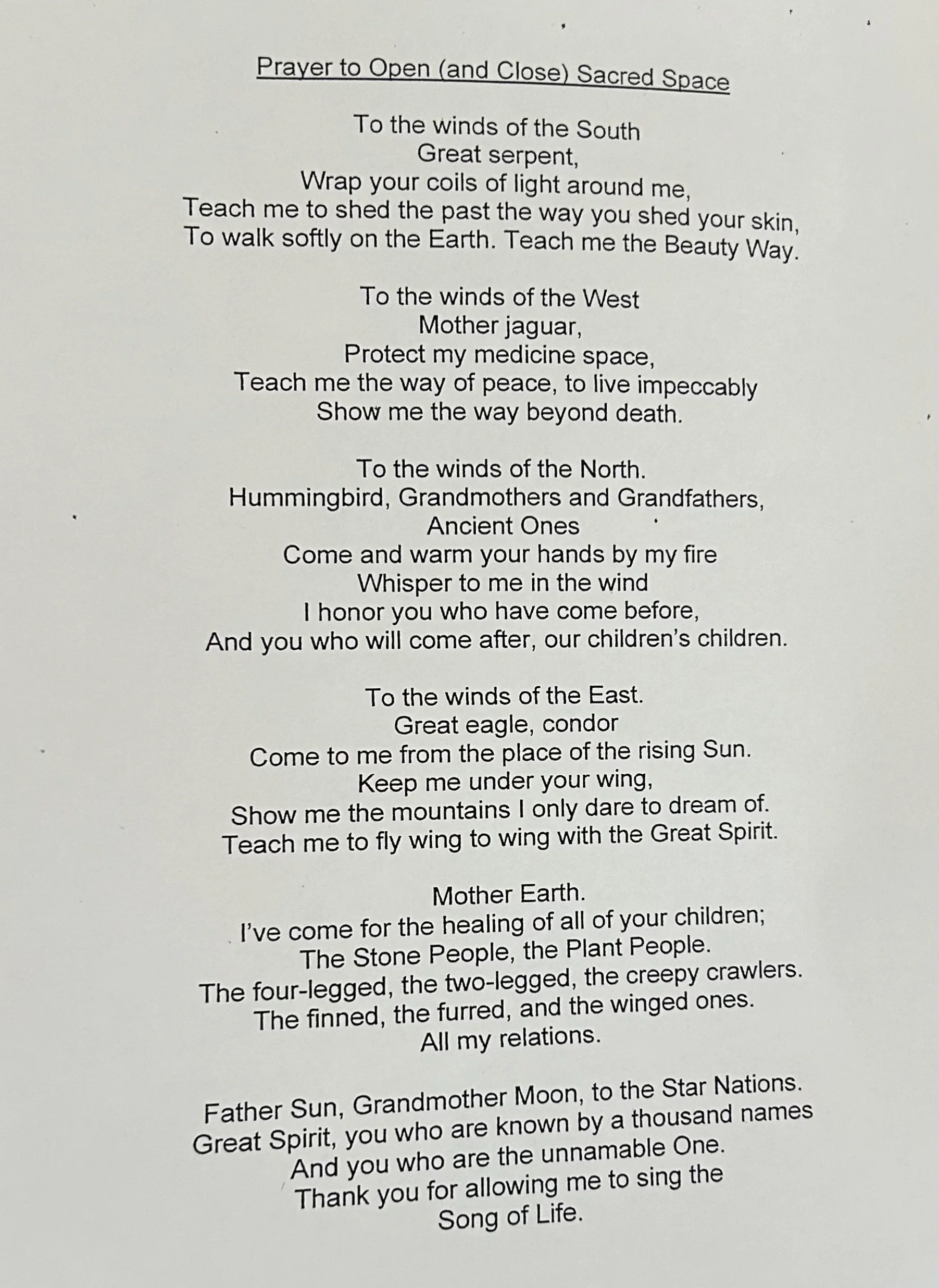
Prayer for Opening (And Closing Sacred Space)
Assagioli’s Egg Model
‘Jaguar teaches: what dies at the threshold is often not the soul, but the costume the soul has outgrown.’